Category: Media

  • Rachel Smith will serve no additional jail time in child death case

    SANTA FE — A woman who was acquitted of killing an infant at a Santa Fe motel in March 2017 got credit for time served while awaiting trial for convictions on lesser charges and will no longer be incarcerated.

    In a trial that began in June, Rachel Smith, 27, was found not guilty of child abuse resulting in death after she was charged killing 3-month-old Jonathan Valenzuela at the Thunderbird Inn on Cerrillos Road. Smith was babysitting Jonathan and his older sister for their then 17-year-old mother.

    Em080619f

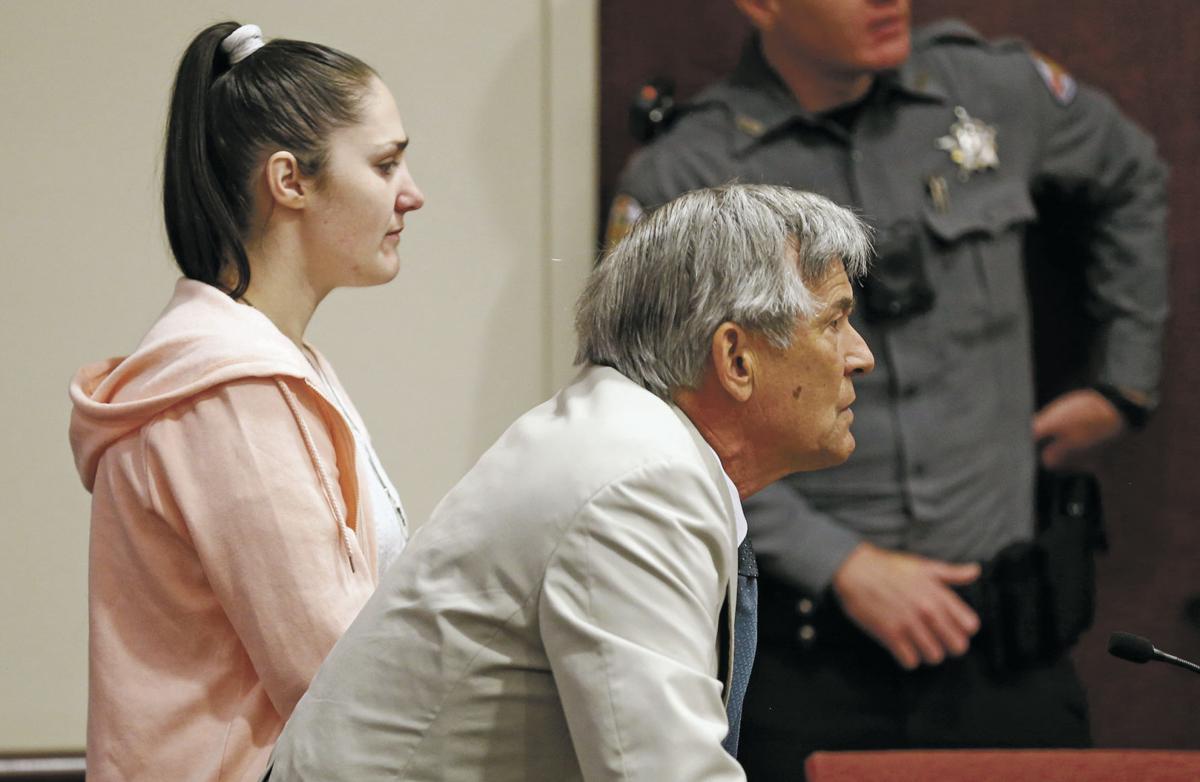
    Rachel Smith talks with her attorney Stephen Aarons after her sentencing hearing in Santa Fe on Tuesday. (Eddie Moore/Albuquerque Journal)

    But Smith was found guilty of one count of obstructing an investigation of child abuse and neglect for initially lying to police about being the children’s mother as well as one count of possession of drug paraphernalia.

    Smith faced two years in jail on those convictions. But since she was arrested in March 2017 and was later put on house arrest, which counts as incarceration, Smith faces no additional jail time.

    “You have no further sentence to serve in this case,” Santa Fe District Court Judge Mary Marlowe Sommer told Smith at a sentencing hearing Tuesday.

    According to Smith’s testimony at trial, Jonathan stopped breathing when she was feeding him with a bottle around 5 a.m. March 11, 2017. Smith went outside her motel room and started screaming for help, prompting bystanders to come to her aid. Police arrived and were unable to revive Jonathan.

    Although Smith, who said she was addicted to heroin at the time, had admitted to using heroin the night before, she has always denied hurting the infant. Smith has since sought treatment for her addiction, and Marlowe Sommer urged Smith to continue her treatment on Tuesday.

    Investigators initially believed Smith may have suffocated Jonathan by accidentally rolling on top of him as she slept, but an autopsy later revealed that he died of blunt force trauma to the head.

    One of Smith’s lawyers, Stephen Aarons, argued that Jonathan’s mother, Angel Arellano, caused the fatal injuries before leaving the children with Smith, which Arellano denied.

  • Smith found not guilty in baby’s death


    Smith, 28, was found guilty on two counts of obstructing the investigation into the child’s death and drug possession. Because she has already served more than two years in custody on electronic monitoring, her lawyer asked she be released for time served.

    Chief Judge Marlowe Summer agreed. Smith’s remaining sentencing is still pending.

    Trembling slightly, both Smith and a defense attorney, Hugh Dangler, appeared to cry after the verdict was read. Several members of Smith’s family brought their hands together in prayer to thank Dangler as the courtroom emptied.

    “I am extremely grateful for the jury’s work … and extremely grateful for their decisions,” Dangler said.

    The baby’s mother, Angel Arellano, 20, exited the courtroom, sobbing in a summer dress.

    On March 11, 2017, Smith had been babysitting the infant, Jonathan Valenzuela, and his 2-year-old sister at her room at the Thunderbird Inn, when she awoke to find the baby had stopped breathing.

    Smith, from Glorieta, admitted to police she had injected heroin the night before the baby’s death, and was indicted on charges of reckless disregard, which could incur an 18-year prison sentence. Police initially believed Smith, who had been watching the children for 33 or 34 hours, may have rolled over the baby in her sleep.

    An autopsy report later showed there had been bleeding in Valenzuela’s brain, likely caused by blunt force trauma, and broken bones in the infant’s neck, consistent with strangulation.

    Prosecutors for the state asked during the trial if she had harmed the baby in a stage of drug withdrawal, as the heroin left her system.

    The trial was postponed in March when new evidence raised questions over whether the baby’s mother, Arellano, might have shaken or injured the baby before leaving him in Smith’s care. Arellano has said she did not harm her son.

    Dr. Heather Jarrell, a neuropathologist with the New Mexico Office of the Medical Investigator, and a witness for state prosecutors, said earlier this week the injuries could have been caused within 24 or 48 hours of the baby’s death.

    The jury, composed of six men and six women, deliberated for two hours after closing arguments concluded Tuesday and returned Wednesday morning just after 11 a.m.

    “This is a mysterious death,” Dangler said. “And will probably remain so.”


    By Rebecca Moss, Santa Fe New Mexican (C) 2019 Reprinted with Permission


    Sitter’s lawyer requests immunity for mother in testimony about dead boy

    Rachel Smith has spent the better part of the past two years in the county jail awaiting trial on a charge that she caused the death of a 3-month-old infant left in her care in a Cerrillos Road motel room in 2017.

    But Smith’s defense attorney and prosecutors recently told a state district judge that new evidence raises the possibility that the child’s mother, Angel Arellano, might have inflicted the injuries that led to the death of Jonathan Valenzuela.

    Arellano had dropped off the boy and his 2-year-old sister at the motel to be cared for by Smith.

    State District Judge Mary Marlowe Sommer postponed Smith’s trial this month — just three days before it was set to begin — to give investigators time to pursue new leads in the case, including allegations that Arellano confessed to an acquaintance she had hurt her son.

    “It would be extremely difficult, if not unethical, for the state to go forward with the trial at this point without setting our minds at ease that we do indeed have the right person in the courtroom,” Assistant District Attorney Larissa Breen said during a court hearing.

    Smith is now out on bail with electric monitoring. She still faces a first-degree felony charge that could send her to prison for up to 18 years.

    Arellano’s attorney, Marc Edwards, said Friday that he had just taken her on as a client and could not comment for this story. Arellano hasn’t been charged.

    Smith’s defense lawyer, Stephen Aarons, recently filed a motion asking the court to approve an arrangement that he hopes will encourage the child’s mother to testify on Smith’s behalf at trial, even if it means implicating herself.

    Aarons is asking the court to grant “use immunity” to Arellano, who is listed as a witness for the state. Such immunity would prevent prosecutors from using anything she said on the stand during Smith’s trial to prosecute her for her son’s death.

    The immunity would not prevent the state from prosecuting her based on other evidence.

    Without the immunity, Aarons says in his motion, Arellano will invoke her Fifth Amendment right against self-incrimination by remaining silent during Smith’s trial.

    Arellano attempted to abort her son by self-harm while pregnant, screamed that she did not want the baby and threatened suicide before he was born, the lawyer says in his motion. He also wrote that Arellano gave the baby to Smith about 33 hours before his death. “The baby could have been grabbed by the throat and violently shaken before this final exchange,” Aarons wrote.

    Smith assumed care of Jonathan and his sister on March 10, 2017, according to police reports. She told police she fed him and put him to bed but awoke the next morning to find he was not breathing. She then called 911.

    The child had no visible injuries. Smith told investigators she had used heroin the night before, and police originally speculated she may have rolled over on the child in the night.

    An autopsy revealed the boy died from bleeding in the brain caused by blunt force trauma.

    The father of a man with whom Arellano — then 17 — was involved at the time has since told police that Arellano told his son that she had harmed the boy before delivering him to Smith, according to court filings.

    Assistant District Attorney Breen is opposing Aarons’ motion, saying that granting Arellano immunity would devastate the state’s chances of prosecuting her if the Santa Fe Police Department’s renewed investigation reveals Arellano was responsible for the infant’s death.

    “The state has no doubt Defendant would like to have Ms. Arellano have leave to testify she may have actually killed [Jonathan], if that is indeed what she will say,” Breen wrote in a motion filed Friday in state District Court, “but the court has to look at the potential detriment to the public interest in getting justice for [the baby’s] death.”

    A spokesman for District Attorney Marco Serna said in an email that Smith’s attorney hasn’t provided documentation to support new allegations involving Arellano.


    Woman held in infant death granted release in Santa Fe

    Woman held in infant death granted release
    Rachel Smith sits with attorneys during a hearing in District Court on Tuesday. Smith was being held in the death of 3-month-old she was baby-sitting.PHAEDRA HEYWOODTHE NEW MEXICAN

    Rachel Smith, 27, had been in jail since her March 2017 arrest in connection with the death of the baby boy at a Cerrillos Road motel.

    The infant’s mother — then 17 years-old — had left two children with Smith for five days preceding the death, according to court records, and Smith was living with the children in the Thunderbird Motel when she woke up one morning to find the baby was not breathing.

    Investigators originally speculated that Smith — a heroin addict who admitted shooting up in the bathroom while she was watching the boy and his 2 year-old sister — might have rolled over on the boy. However, an autopsy later revealed the infant had bleeding in his brain consistent with “blunt force trauma.”

    Smith’s defense attorney, Stephen Aarons, filed a motion in November seeking to have the charges dismissed on grounds that her rights to a speedy trial and discovery of evidence had been violated. Among other things, he argued that it took prosecutors about a year to produce Children Youth and Family Department records that could include evidence that the infant’s mother had abused him.

    State District Judge Mary Marlowe Sommer postponed her decision on that motion during a hearing Tuesday, saying she needed to review the Children Youth and Family Department records before ruling.

    Aarons also filed a motion challenging one of the state’s expert witnesses, saying the proposed witness’s opinions on “shaken baby syndrome” as it relates to pinpointing when the child received the fatal injury are not typical and have been contradicted in literature that says determining time of injury is the unreliable “Achilles heel” of forensic pathology.

    Sommer also postponed ruling on that motion Tuesday, directing Aarons and Assistant District Attorney Larissa Breen to expand written briefs on the issue before the judge considers the matter again next month.

  • Lifetime Achievement Award

    Dear Mr. Aarons,

    My name is Joy Forrler and I am a Director with Marquis Who’s Who. As you know, you have been a listee with Marquis for many years. Throughout the years while maintaining your biography, we’ve been so impressed with all of the accomplishments you have made during your career as an attorney. The dedication that you have always put into your profession is very important to Marquis, and that is why you were chosen by the Marquis Research Committee to receive the “Albert Nelson Marquis Lifetime Achievement Award”.  Since 1899, when we first published Who’s Who in America, we have been identifying noteworthy individuals for inclusion in our Who’s Who titles. Selection has always been based on positions of responsibility held, contributions to the field, and noteworthy accomplishments.

    Now, with the introduction of the Lifetime Achievement Awards program,  we are taking the next step by identifying luminaries who have achieved such eminence that they stand out even from our other Who’s Who listees. Perhaps most importantly, we would like to share your impressive accomplishments with the world, by distributing an announcement to major search engines that you have been honored with this prestigious award. Your award will be online forever and will serve as your legacy so future generations can read about your contributions and accomplishments.

    We will be creating and distributing a documented narrative about you online to the major search engines that will serve as your legacy. This narrative will remain online for generations to come so that when colleagues/ clients/ peers/ family members conduct an online search for your name, your narrative will appear. You will also be featured on the “Marquis Who’s Who Lifetime Achievement” website and your expanded biographical profile will be published in the Marquis Biographies Online registry permanently. You will be issued a personalized username and password for access to our proprietary online database to collaborate with the most distinguished people around the world.  You will also receive a beautiful wall plaque to commemorate your selection.

    Feel free to click on the link below for more information: https://wwlifetimeachievement.com 

    Please contact me at your earliest convenience, and be sure to let me know the best date, time and phone number to reach you. I’m looking forward to speaking with you.

    Best regards,

    Joy Forrler

    Submissions Director

    Marquis Who’s Who

    Phone: (908) 673-0100 ext. 4918

    Fax: (908) 356-0184

    jforrler@marquisww.com

    www.marquiswhoswho.com

    https://history.marquiswhoswho.com/milestone

  • Expungement in New Mexico

    In 2019, New Mexico enacted a comprehensive law authorizing expungement (sealing) of most non-conviction records, and of conviction records in all but the most serious violent and sexual crimes.  Effective January 1, 2020, the Criminal Record Expungement Act (CREA) authorizes courts to limit public access to all but a limited category of non-conviction records after a one-year waiting period, as long as no charges are pending against the individual.  Courts are also authorized to seal the record of most convictions after waiting periods ranging from two to ten years, upon a finding that “justice will be served by an order to expunge.”  Upon taking effect, New Mexico’s CREA will be one of the broadest record-closing authorities in the Nation.  See HB 370, not yet codified.

    Prior to CREA’s enactment, New Mexico’s courts were authorized to seal records only of juvenile adjudications, of first drug offenses committed under the age of 18, or of crimes committed by victims of human trafficking (all three authorities survive the new law and are described below).3 Administrative authority to seal non-conviction records, which applies only to records of certain misdemeanors or petty misdemeanors, is repealed by the new law.4  Section 3 of CREA also repeals an existing authority for courts to seal records in cases involving identity threat, and replaced it with a more efficient authority.

    1.  Expungement of conviction records 

    Under § 5A of CREA, a “person convicted of a violation of a municipal ordinance, misdemeanor or felony, following the completion of the person’s sentence and the payment of any fines or fees owed to the state for the conviction, may petition the district court in which the person was convicted for an order to expunge arrest records and public records related to that conviction.”  An eligibility waiting period of between two and ten years is required,5 depending on the seriousness of the offense, during which the person may not have been convicted of any additional offenses.  A few felony and misdemeanor offenses are ineligible for relief, including those involving a child, great bodily harm or death, sex, embezzlement, or driving under the influence of alcohol or drugs.  See § 5(G).  Notice must be given to the district attorney and the arresting agency.

    The court “shall issue an order within thirty days of the hearing requiring that all arrest records and public records related to the conviction be expunged” if it finds that no other changes are pending against the petition, that victim restitution has been paid, and that “justice will be served by an order to expunge” after considering the following:

    • the nature and gravity of the offense or conduct that resulted in the petitioner’s conviction;
    • the petitioner’s age, criminal history, and employment history;
    • the length of time that has passed since the offense was committed and the related sentence was completed;
    • the specific adverse consequences the petitioner may be subject to if the petition is denied; and
    • any reasons to deny expungement submitted by the district attorney.

    Effect of expungement

    “Expungement” is defined in § 2 of CREA as “the removal from access to the general public of a notation of an arrest, complaint, indictment, information, plea of guilty, conviction,    acquittal, dismissal or discharge record, including a record posted on a publicly accessible court, corrections or law enforcement internet website.”  Section 7 provides that

    entry of an order to expunge, the proceedings shall be treated as if they never occurred, and officials and the person who received the order to expunge may reply to an inquiry that no record exists with respect to the person; provided that arrest or conviction records shall be disclosed by the person and officials in connection with any application for or query regarding qualification for employment or association with any financial institution regulated by the financial industry regulatory authority or the securities and exchange commission.

    2. Expungement of non-conviction records

    The only pre-2020 authority for sealing non-conviction records authorizes the State Department of Public Safety to seal records of certain misdemeanors or petty misdemeanors.  See N.M. Stat. Ann. § 29-3-8.1(a).  That authority is repealed by Section 8 of CREA.

    Under § 4 of CREA, courts are authorized upon petition to expunge “records upon release without conviction,” which are defined to include acquittals, nolle prosequis or dismissals, a pre-prosecution referral to diversion, an order of conditional discharge (see below), or any other discharge.  (Note that it does not include a deferred imposition of sentence under N.M. Ann. § 31-20-3, discussed below, which constitutes a conviction under New Mexico law and must be addressed via § 5.)  A one-year waiting period applies, and no charges can be pending.  CREA authorizes sealing for the first time in several existing diversionary dispositions (see below).  The only arrest records that may not be sealed are DUI citations and related police dispatch and breathalyzer records.

    3.  Deferred imposition of sentence

    N.M. Stat. Ann. § 31-20-3 provides for deferred imposition of sentence after a guilty plea (resulting in conviction under New Mexico law), and restoration of all civil rights upon discharge.   See United States v. Reese, 326 P.3d 454 (N.M. 2014)(completion of conditions and discharge restores all civil rights).  In Reese, the New Mexico Supreme Court stated that “[u]nder New Mexico Law, a dismissal order following the completion of a deferred sentence is effectively a legislatively created judicial pardon.”  Slip op. at 7.  Effective January 1, 2020, courts will have authority after a waiting period to expunge records in cases resulting in a discharge under this authority, under the provisions of § 5 of the Criminal Record Expungement Act of 2019, discussed above.  (Because this disposition is considered a conviction under New Mexico Law, the applicable waiting period is determined under § 5 rather than § 4, and other eligibility requirements and court findings also apply.)

    4. Conditional discharge with judgment

    Conditional discharge without an adjudication of guilt is available, at the court’s discretion, after successful completion of probation in all cases except those involving a first degree felony so long as the person has no prior felony convictions.6  See N.M. Ann. § 31-20-3 (qualifying offenses); § 31-20-13 (conditional discharge authority).   “A conditional discharge order may only be made available once with respect to any person.”  § 31-20-13.

    Effective January 1, 2020, courts will have authority to expunge records in cases resulting in a conditional discharge under § 31-20-13, upon petition after a one-year waiting period, as long as no charges are pending. See  § 4 of the Criminal Record Expungement Act of 2019. discussed above.7  

    Though a conditional discharge does not result in an adjudication of guilt or a conviction, it may be used for subsequent habitual offender sentencing.  See § 31-18-17.  Gun rights are apparently not lost under state law following discharge, see § 30-7-16(c)(2), nor are federal gun rights lost under 18 U.S.C. § 921(a)(20),  see United States vs. Valerio, 441 F.3d 837, 841 (9th Cir. 2006).

    5.  Conditional discharge for first-time drug possession

    In addition to the general conditional discharge authority under N.M. Stat. Ann. § 31-20-13, first time drug possession offenders may also receive a conditional discharge under distinct authority at § 30-31-28(C).  Conditional discharge under § 30-31-28(C) operates in substantially the same manner as discharge under the general statute, and is only available once.  Until January 1, 2010, records of proceedings resulting in conditional discharge as a first-time drug possession offender may be expunged only if the offender was 18 or younger at the time of commission.  30-31-28(D).  After that date, courts will have authority to expunge records in cases resulting in a conditional discharge under this provision without regard to the petitioner’s age, as under § 31-20-13 (above), after a one year waiting period, as long as no charges are pending.   See  § 4 of the Criminal Record Expungement Act of 2019. discussed above.  Discharge under section 30-31-28 “shall not be deemed a conviction for purposes of disqualifications or disabilities imposed by law upon conviction of a crime including the penalties prescribed under this section for second or subsequent convictions or for any other purpose.”  § 30-31-28(C).

    6.  Sealing of juvenile records

    Juvenile records are generally unavailable to the public. N.M. Stat. Ann. § 32A-2-32.  Sealing is available under N.M. Stat. § 32A-2-26.  Upon motion to the court made by a person over 18 years old (or younger, upon a showing of good cause), the court is required to seal all records so long as two years have passed since release from custody/supervision (or entry of judgement), and there have been no subsequent adjudications or convictions for any felony or misdemeanor involving moral turpitude during that time, and no charges are pending.  § 32A-2-26(A).  A sealed record is treated as though proceedings never took place, and a person may deny the existence of any sealed record.  § 32A-2-26(C).  See also § 31-30-28, discussed supra, allowing for expungement of drug possession proceedings.

    7.  Sealing for victims of human trafficking
    On petition to the district court, a victim of human trafficking who has been “charged with crimes arising out of the actions of someone charged with human trafficking may have all legal and law enforcement records of the charges and convictions in the person’s case sealed,” as long as the “charge or conviction is for a non-homicide crime.” N.M. Stat. § 30-52-1.2.  The court must find that the “petitioner’s involvement in the offense was due to duress, coercion, use of force, threat to or fraud committed against the petitioner by a person who has committed human trafficking involving the petitioner,” and must give “reasonable notice of the petition” to the district attorney who filed the original case.  “Upon the entry of the sealing order, the proceedings in the case shall be treated as if they never occurred and all index references shall be deleted.” § 30-52-1.2 (C).   “Inspection of files and records or release of information in the records included in the sealing order may be permitted by the court only upon subsequent order of the court on a showing of good cause after notice to all parties to the original petition.”  § 30-52-1.2(D).


  • Governor Signs Expungement Bill

    Gov. Michelle Lujan Grisham signed a series of criminal justice bills into law Wednesday, allowing more New Mexicans to expunge records of past arrests or convictions and banning employers from asking about criminal history on an initial job application. In signing the bills, the new Democratic governor contrasted herself with Republican predecessor Susana Martinez, a former prosecutor who vetoed some similar measures in past years.

    Each of the bills passed with at least some bipartisan support during the 60-day session that ended last month. But the governor’s move Wednesday showed how far the state has pivoted on criminal justice issues in just a few months.

    “We will never, ever weaken our resolve to be tough on the worst offenders. But we will responsibly take steps to assist our friends and neighbors who deserve a second chance to contribute to our society,” Lujan Grisham said in a statement after signing the series of bills.

    Still, while other parts of the country have had similar laws in place for years, the big test may be putting these laws into practice for the first time in New Mexico.

    Senate Bill 370, which will take effect Jan. 1, 2020, will allow people to ask a court to seal records of their arrest or conviction.

    Known as expunction, the process is strictly limited under current law to arrests for misdemeanors or petty misdemeanors. Even then, records cannot be expunged for crimes of “moral turpitude.”

    Most states have embraced expunction, however, as a means of helping people who have completed their sentences, were wrongly arrested or were victims of identity theft to find employment and get back to a normal life once untangled from the criminal justice system.

    In turn, proponents say, such measures boost employment and prevent repeat offenses.

    “We focus so much on the politics of penalties, the politics of punishment and trying to do punishment as a deterrent to crime,” said Rep. Antonio “Moe” Maestas, a Democrat from Albuquerque who sponsored the bill. “We finally realized the facts don’t bear that out. You have to deal with recidivism. The No. 1 crime fighter is a job.”

    New Mexico will still prohibit expunction for crimes against children, sex offenses, drunken driving, embezzlement and offenses that cause great bodily harm or death to another person.

    A judge must still decide on each qualifying case, the court will have to notify victims and records will still show up in background checks for firearm purchases or sensitive jobs such as at national laboratories.

    Some lawmakers and government transparency advocates opposed the bill — raising concerns it would deprive the public and potential employers of information they might want to know about a person they are hiring or allowing into their homes.

    “The bill violates the most basic principle of the public’s right to know by erasing what is and has historically been a public record,” the New Mexico Foundation for Open Government said in a statement.

    SB 96 bars employers from asking about past arrests or convictions on an initial job application.

    Known as the “ban the box” bill, in reference to the box job applicants sometimes must check on a form that inquires about their criminal history, the legislation is similar to laws enacted in at least 33 other states, according to the National Employment Law Project.

    Under the law, which will take effect by mid-June, employers may still ask about a job applicant’s criminal record in the interview process but not on a first application.

    Backers say that will at least give people with criminal records a chance at an interview and, perhaps, a job.

    Sponsored by Rep. Alonzo Baldonado, R-Belen, and Sen. Bill O’Neill, D-Albuquerque, the idea has united an unlikely coalition of liberal and conservative backers who see it as an issue of empowerment, redemption and civil rights.

    Though the governor did not mention it in her statement, another bill, SB 323, also could prevent many people from ending up with a criminal record.

    Sponsored by Sen. Joseph Cervantes, D-Las Cruces, the bill effectively decriminalizes possession of small amounts of cannabis. Starting in July, possession of up to half an ounce of cannabis will be punishable by a $50 fine. It will count as a penalty assessment, not a criminal conviction.

    An analysis of the bill by legislative aides suggested it would cut the cost to courts of processing petty cannabis possession cases and save time for police officers.

    Prison reform advocates also scored a victory when the governor signed HB 364, which will limit the use of solitary confinement in prisons and detention centers around New Mexico.

    Civil rights advocates have argued for years that the practice of isolating inmates and giving them little contact with other people can have lasting consequences on their mental health.

    The law specifically restricts the use of solitary confinement for those under age 18, pregnant women and people with mental illnesses. It also will require the state Corrections Department report regularly on its use of solitary confinement. It will require private prison companies disclose legal settlements with inmates or former inmates. In turn, HB 364 will provide new insight into conditions inside the state’s prisons.

    Still, there is deep skepticism of the Corrections Department, which the American Civil Liberties Union found has been underreporting its use of solitary confinement.

    “They lie and they lied for years about solitary confinement,” Rep. Jane Powdrell-Culbert, R-Corrales, said during a House debate on the bill.

    It will be up to a new Corrections Department secretary to implement much of the law. But Lujan Grisham, whose original nominee for the position withdrew, has yet to name someone else to lead the agency.

    HB 364 was sponsored by Sen. Mary Kay Papen, D-Las Cruces, as well as Reps. Maestas, Liz Thomson, D-Albuquerque, and Andrea Romero, D-Santa Fe.

    Parts of the new law will take effect July 1.

  • Sitter’s lawyer requests immunity for mother in testimony about dead boy

    Rachel Smith has spent the better part of the past two years in the county jail awaiting trial on a charge that she caused the death of a 3-month-old infant left in her care in a Cerrillos Road motel room in 2017.

    But Smith’s defense attorney and prosecutors recently told a state district judge that new evidence raises the possibility that the child’s mother, Angel Arellano, might have inflicted the injuries that led to the death of Jonathan Valenzuela.

    Arellano had dropped off the boy and his 2-year-old sister at the motel to be cared for by Smith.

    State District Judge Mary Marlowe Sommer postponed Smith’s trial this month — just three days before it was set to begin — to give investigators time to pursue new leads in the case, including allegations that Arellano confessed to an acquaintance she had hurt her son.

    “It would be extremely difficult, if not unethical, for the state to go forward with the trial at this point without setting our minds at ease that we do indeed have the right person in the courtroom,” Assistant District Attorney Larissa Breen said during a court hearing.

    Smith is now out on bail with electric monitoring. She still faces a first-degree felony charge that could send her to prison for up to 18 years.

    Arellano’s attorney, Marc Edwards, said Friday that he had just taken her on as a client and could not comment for this story. Arellano hasn’t been charged.

    Smith’s defense lawyer, Stephen Aarons, recently filed a motion asking the court to approve an arrangement that he hopes will encourage the child’s mother to testify on Smith’s behalf at trial, even if it means implicating herself.

    Aarons is asking the court to grant “use immunity” to Arellano, who is listed as a witness for the state. Such immunity would prevent prosecutors from using anything she said on the stand during Smith’s trial to prosecute her for her son’s death.

    The immunity would not prevent the state from prosecuting her based on other evidence.

    Without the immunity, Aarons says in his motion, Arellano will invoke her Fifth Amendment right against self-incrimination by remaining silent during Smith’s trial.

    Arellano attempted to abort her son by self-harm while pregnant, screamed that she did not want the baby and threatened suicide before he was born, the lawyer says in his motion. He also wrote that Arellano gave the baby to Smith about 33 hours before his death. “The baby could have been grabbed by the throat and violently shaken before this final exchange,” Aarons wrote.

    Smith assumed care of Jonathan and his sister on March 10, 2017, according to police reports. She told police she fed him and put him to bed but awoke the next morning to find he was not breathing. She then called 911.

    The child had no visible injuries. Smith told investigators she had used heroin the night before, and police originally speculated she may have rolled over on the child in the night.

    An autopsy revealed the boy died from bleeding in the brain caused by blunt force trauma.

    The father of a man with whom Arellano — then 17 — was involved at the time has since told police that Arellano told his son that she had harmed the boy before delivering him to Smith, according to court filings.

    Assistant District Attorney Breen is opposing Aarons’ motion, saying that granting Arellano immunity would devastate the state’s chances of prosecuting her if the Santa Fe Police Department’s renewed investigation reveals Arellano was responsible for the infant’s death.

    “The state has no doubt Defendant would like to have Ms. Arellano have leave to testify she may have actually killed [Jonathan], if that is indeed what she will say,” Breen wrote in a motion filed Friday in state District Court, “but the court has to look at the potential detriment to the public interest in getting justice for [the baby’s] death.”

    A spokesman for District Attorney Marco Serna said in an email that Smith’s attorney hasn’t provided documentation to support new allegations involving Arellano.

    (c) 2019 Santa Fe New Mexican, reprinted with permission
  • Ex-teacher in Ojo Caliente convicted of sexual contact of minor

    A Rio Arriba County jury convicted a former high school teacher of two counts of sexual contact of a minor and five counts of sexual penetration of a minor Thursday following a single-day trial in Tierra Amarilla.

    Miguel G. Garcia worked at Mesa Vista High School in Ojo Caliente from 2008-15, according to the Rio Grande Sun newspaper.

    If sentenced to the maximum on each of the counts, Garcia faces 10½ years in prison.

    “Our office worked diligently to secure multiple felony convictions against this predator and combating sexual violence against children will continue to be our priority,” state District Attorney Marco Serna said in an email Thursday.

    Garcia’s attorney did not respond to an email seeking comment.

    Garcia, 37, of Española, was accused in 2015 of sexually assaulting his victim — a girl between the ages of 13 and 18 — between 2012 and 2013, according to court records.

    Garcia was charged with two other counts of child solicitation by electronic communication device, but those charges were severed from the case.

    Correction: An early version of this story incorrectly reported that two counts of child solicitation by electronic communication device were dropped. The counts were not dropped, but rather severed from the case.

    New Mexican (c) reprinted with permission

  • Criminal Record Expungement Act heads to Senate with bipartisan support

    A bill that allows people to get an arrest or conviction taken off their record is making its way through the legislature. The Criminal Record Expungement Act is gathering a lot of support with Republicans as well as Democrats.

    House Bill 370 is sponsored by Albuquerque Democrat Antonio “Moe” Maestas and it allows people who have completed their sentence to petition the court and get their permission to have their record expunged.

    He says the bill allows people to move on with their lives and get a second chance. Maestas says it’s especially beneficial when people are applying for jobs.

    “You’re in your 40s and you got arrested when you were 19, that would not show up if it’s expunged. It’s an economic development tool for folks to get better jobs as well as better safety,” said Maestas.

    Prosecutors and police would still have access to the records but they would be removed from public view. Some offenses wouldn’t be eligible for expungements such as homicide, sex crimes, crimes against children, great bodily harm, DWI or embezzlement.

    However, critics say people shouldn’t have the right to hide their past from the public especially employers. Rep. Maestas says if this is passed, New Mexico will be one of the last states in the country to pass this type of law.

  • Teen once charged in Santa Fe shooting death arrested in new case

       A 17-year-old Santa Fe boy who prosecutors maintain was involved in the slaying of a Michigan man in September, despite dropping a murder charge against him, has been arrested in a new shooting case, authorities say.

       Zachary Gutierrez was arrested by Santa Fe police Feb. 12, following a report three days earlier of shots fired near Alto Park and a subsequent high-speed chase with a white Dodge Charger, according to a search warrant affidavit.

       No one was harmed in the Feb. 9 incident in which police believe Gutierrez fired a handgun, ran from the Charger when they arrived at the scene and then fled in a blue pickup, according to the affidavit. A 19-year-old man who drove away in the Charger and led police on a chase was arrested a short time later.

       Police arrived at Gutierrez’s home with the warrant and followed him and a young woman they suspect was the getaway driver of the pickup to a gas station on Airport Road, where they were both taken into custody.

       In October, Gutierrez was arrested and charged in the killing of Richard Milan, 64, who was shot while walking his dog near the intersection of Airport Road and Lucia Lane on the night of Sept. 26. Milan and his wife had been their way home to Kalamazoo, Mich., following a trip to California, when they stopped to see family in Santa Fe. According to police, Milan encountered a group of teens and exchanged words with Gutierrez.

    Milan was shot twice and died.

       Police said at the time that Gutierrez, who had an extensive history of encounters with law enforcement, was believed to have started the altercation with Milan and stood over him, laughing, after shooting him. The teens then fled.

       However, in late November, District Attorney Marco Serna dismissed the murder charge against Gutierrez, saying that his office did not have enough time to present the case to a grand jury before a mid-December deadline. In early November, Serna told The New Mexican the pursuit of an indictment against Gutierrez had to be postponed because his office was reviewing new information.

       Gutierrez’s attorney at the time, Stephen Aarons, said he had given prosecutors an eyewitness video that showed the teen was a bystander and not the shooter.

       The District Attorney’s Office said Wednesday in a statement that Gutierrez remained in custody and was still considered connected to Milan’s killing. The office declined to provide details.

       “My office is working to keep the juvenile defendant in custody and to protect the safety of residents, however, given the active and ongoing nature of the Richard Milan murder investigation and the alleged involvement of a juvenile defendant, it would be inappropriate to comment any further at this time,” Serna said.

       The driver of the Charger in the Feb. 9 incident, Nathaniel Bueno-Diaz, was charged with fleeing from a law enforcement officer, leaving the scene of a car accident, possession of a firearm by a felon and tampering with evidence, according to a criminal complaint. Police said he led them on an extensive chase, ran red lights, drove into oncoming traffic and hit two vehicles.

       The search warrant affidavit, filed in District Court on Friday, said Bueno-Diaz told investigators after his arrest that Gutierrez was his cousin and that the two had been trying to buy drugs when he saw Gutierrez fire several rounds from a Glock handgun with an extended magazine.

       Bueno-Diaz said Gutierrez had attacked and stolen the gun from another man earlier that day. Bueno-Diaz told police that when officers pulled them over, Gutierrez pointed the Glock at him and told him to flee. Police said Bueno-Diaz threw a second handgun from his vehicle during the chase that ensued. That handgun has not been found, according to the affidavit.

  • Court questions appeal in Fabian Gonzales case

    BY KATY BARNITZ / JOURNAL STAFF WRITER

    ALBUQUERQUE, N.M. — The state Court of Appeals is asking the District Attorney’s Office to explain whether its appeal in the Fabian Gonzales case should be dismissed as moot following his cousin’s no contest plea.

    Gonzales, along with his cousin Jessica Kelley, are defendants in a case centered on the death of 10-year-old Victoria Martens. In an agreement last month with the DA’s Office, Kelley pleaded no contest to reckless child abuse resulting in death, tampering with evidence and aggravated assault. She also promised to testify against Gonzales.

    Prosecutors in September appealed Judge Charles Brown’s decision to exclude statements Jessica Kelley made in jail, along with evidence of her drug use and prior convictions.

    Gonzales had been set for trial in mid-October, but the appeal put his case on hold indefinitely.

    In an order filed last Thursday, the Court of Appeals noted that Kelley’s plea agreement and availability to testify may have rendered moot the argument asserted in the appeal.

    A spokesman for the DA’s Office said prosecutors will file a response in coming days.

    Gonzales’ attorney Stephen Aarons filed a response asking the court to dismiss the appeal and send the case back to the District Court for trial.