Category: Domestic Violence

  • NM Court of Appeals affirms Fabian Gonzales’ release

    ALBUQUERQUE, N.M. — Finding it was in accordance with the law and supported by substantial evidence, the state Court of Appeals has affirmed a local judge’s decision to release the man facing charges surrounding the death of 10-year-old Victoria Martens.

    In opting to free Fabian Gonzales, the Court of Appeals wrote, Judge Charles Brown properly considered the defendant’s lack of felony convictions, the dismissal of some of his most serious charges and the strength of the remaining allegations against him.

    Shortly after the child was found dead in her family’s apartment, authorities said that Gonzales had drugged, raped and killed her before dismembering her body. But eventually evidence surfaced showing that Gonzales was not at the apartment at the time of Victoria’s death. The state’s latest theory of the case charges Gonzales with tampering with evidence and child abuse resulting in death. He is accused of helping his cousin dismember the girl’s body after she was reportedly killed by an unidentified man who was looking for Gonzales.

    Gonzales’ attorney did not immediately respond to a request for comment.

    A spokesman for the District Attorney’s Office, which filed the unsuccessful appeal, said the office is weighing its options “in order to best protect the community from Gonzales.”

    Gonzales’ attorney Stephen Aarons said in a statement that his client “has been waiting 1,189 days for his day in court.” “The public has a right to know what really happened,” Aarons wrote. “It is high time for the district attorney to stop delaying this trial.”

    Brown’s decision was the subject of social media rage and a protest in front of District Court in Downtown Albuquerque. Gonzales was finally released from jail last week after a more than three-year stay.

    The Court of Appeals order comes less than a week after the state asked the court to review Brown’s decision. In their appeal, prosecutors explained why they believed Gonzales “poses a clear threat to the safety of the community” and should have been detained as he awaits trial in the case.

    They also say Brown found Gonzales was not a threat because his record consists only of misdemeanor convictions and because his most egregious charges had been dismissed. They argued that the decision effectively created a rule requiring prior felony convictions or murder or rape charges in order to classify a defendant as a danger.

    Read the unanimous decision of the Court of Appeals

    Albuquerque Journal ©2019 Reprinted with permission. Contact the writer.

  • Order Affirming Release of Fabian Gonzales

    1 IN THE COURT OF APPEALS OF THE STATE OF NEW MEXICO
    2 STATE OF NEW MEXICO,
    3 Plaintiff-Appellant,
    4 v.                                                       No. A-1-CA-38570
    5                                                           D-202-CR-2016-02961
    7 FABIAN ELIAS GONZALES,
    8 Defendant-Appellee.
    9
    10 ORDER AFFIRMING DISTRICT COURT’S DENIAL OF STATE’S
    11 MOTION FOR PRETRIAL DETENTION
    12 This matter comes before the Court on the State’s expedited appeal, filed under
    13 Rule 12-204 NMRA, from the district court’s order denying the State’s motion for
    14 pretrial detention. The Court has reviewed the State’s motion, accompanying exhibits,
    15 transcript of the November 6, 2019 hearing, and the parties’ district court filings
    16 related to this matter. Having considered the same, as well as the applicable law, this
    17 Court concludes that the district court’s decision to deny the State’s motion for
    18 pretrial detention is supported by substantial evidence, is not arbitrary or capricious,
    19 and is otherwise in accordance with the law. See Rule 12-204(D)(2)(b) (providing the
    20 standard of review applied by appellate courts in reviewing pretrial detention
    21 decisions); State v. Groves, 2018-NMSC-006, ¶¶ 24-25, 410 P.3d 193. We note, in

    1 concluding that the district court did not err in determining that the State failed to
    2 meet its burden under Rule 5-409(F)(4) NMRA, the district court properly considered
    3 Defendant’s lack of felony convictions; the fact that Defendant’s past misdemeanor
    4 charges occurred over a seventeen-year period; the strength of the State’s remaining
    5 case against Defendant; and the fact that the State has dismissed all intentional violent
    6 offenses with which Defendant had been originally charged, including murder,
    7 criminal sexual penetration, and intentional child abuse.
    8 Furthermore, to the extent the State seeks review of the district court’s decision
    9 not to impose a monetary bond, the district court’s decision in this regard is not
    10 properly before this Court on appeal. See Rule 5-405(A)(3)(b) NMRA (providing that
    11 the “state may appeal if the district court has denied the prosecutor’s motion for
    12 pretrial detention,” and recognizing a defendant’s limited ability to appeal a district
    13 court order requiring a secured bond when the defendant continues to be detained as
    14 a result of an inability to pay, but not identifying any right by the state to appeal a
    15 district court’s refusal to set a monetary bond).

    1 It is hereby ORDERED that the district court’s order denying the State’s
    2 motion for pretrial detention is AFFIRMED.
    ____________________________________
    s/ J. MILES HANISEE, Chief Judge
    s/ M. MONICA ZAMORA, Judge
    s/ BRIANA H. ZAMORA, Judge

    Filed 11/25/2019 4:27 PM

  • Woman acquitted in infant’s death won’t receive more time

    Babysitter was sentenced for other crimes but served two years while awaiting trial

    Rachel Smith

    A woman acquitted last month of causing the death of an infant she was babysitting at a Santa Fe motel will serve no additional time for possessing drug paraphernalia and obstructing a police investigation by initially pretending to be the child’s mother.

    A judge on Tuesday sentenced Rachel Smith, 27, to just under two years for those crimes. But counting time spent in jail and on electronic monitoring, Smith already had undergone more than two years of incarceration while awaiting trial.

    Authorities charged Smith in the 2017 death of 3-month-old Jonathan Valenzuela after medics arrived at the Cerrillos Road motel in response to her frantic 911 call reporting the child was not breathing. Responders found the baby dead.

    Smith said at trial she originally claimed to be the child’s mother in order to protect the baby’s teenage mother from getting in trouble.

    The boy had no visible injuries, and police initially speculated that Smith — who admitted she used heroin in the bathroom while the boy and his 2-year-old sister slept — may have smothered the child by accidentally rolling over on him. But when an autopsy found the child died of strangulation and blunt force trauma, Smith was charged with child abuse resulting in death.

    About a month before the case was set for trial in July, the state got more time to investigate evidence that suggested the child’s mother, Angel Arellano, may have inflicted the child’s fatal injuries. Though prosecutors never charged Arellano and proceeded with their prosecution of Smith, defense attorney Stephen Aarons raised the issue at trial.

    Medical examiner Dr. Heather Jarrell testified that in her opinion the infant’s injuries most likely were inflicted during the time he was under Smith’s care, but she acknowledged under cross-examination it was possible the injuries were inflicted much earlier, while the baby was with his mother.

    A jury found Smith not guilty of child abuse resulting in death, but convicted her of obstructing an investigation and possession of drug paraphernalia. The maximum penalty for each of those misdemeanors is 364 days in jail.

    The child’s mother did not attend the sentencing. Smith declined to comment after the hearing, saying only, “Not right now. I’ve been through enough.”

    • By Phaedra Haywood phaywood@sfnewmexican.com
    • Reprinted with permission
  • Smith found not guilty in baby’s death


    Smith, 28, was found guilty on two counts of obstructing the investigation into the child’s death and drug possession. Because she has already served more than two years in custody on electronic monitoring, her lawyer asked she be released for time served.

    Chief Judge Marlowe Summer agreed. Smith’s remaining sentencing is still pending.

    Trembling slightly, both Smith and a defense attorney, Hugh Dangler, appeared to cry after the verdict was read. Several members of Smith’s family brought their hands together in prayer to thank Dangler as the courtroom emptied.

    “I am extremely grateful for the jury’s work … and extremely grateful for their decisions,” Dangler said.

    The baby’s mother, Angel Arellano, 20, exited the courtroom, sobbing in a summer dress.

    On March 11, 2017, Smith had been babysitting the infant, Jonathan Valenzuela, and his 2-year-old sister at her room at the Thunderbird Inn, when she awoke to find the baby had stopped breathing.

    Smith, from Glorieta, admitted to police she had injected heroin the night before the baby’s death, and was indicted on charges of reckless disregard, which could incur an 18-year prison sentence. Police initially believed Smith, who had been watching the children for 33 or 34 hours, may have rolled over the baby in her sleep.

    An autopsy report later showed there had been bleeding in Valenzuela’s brain, likely caused by blunt force trauma, and broken bones in the infant’s neck, consistent with strangulation.

    Prosecutors for the state asked during the trial if she had harmed the baby in a stage of drug withdrawal, as the heroin left her system.

    The trial was postponed in March when new evidence raised questions over whether the baby’s mother, Arellano, might have shaken or injured the baby before leaving him in Smith’s care. Arellano has said she did not harm her son.

    Dr. Heather Jarrell, a neuropathologist with the New Mexico Office of the Medical Investigator, and a witness for state prosecutors, said earlier this week the injuries could have been caused within 24 or 48 hours of the baby’s death.

    The jury, composed of six men and six women, deliberated for two hours after closing arguments concluded Tuesday and returned Wednesday morning just after 11 a.m.

    “This is a mysterious death,” Dangler said. “And will probably remain so.”


    By Rebecca Moss, Santa Fe New Mexican (C) 2019 Reprinted with Permission


    Sitter’s lawyer requests immunity for mother in testimony about dead boy

    Rachel Smith has spent the better part of the past two years in the county jail awaiting trial on a charge that she caused the death of a 3-month-old infant left in her care in a Cerrillos Road motel room in 2017.

    But Smith’s defense attorney and prosecutors recently told a state district judge that new evidence raises the possibility that the child’s mother, Angel Arellano, might have inflicted the injuries that led to the death of Jonathan Valenzuela.

    Arellano had dropped off the boy and his 2-year-old sister at the motel to be cared for by Smith.

    State District Judge Mary Marlowe Sommer postponed Smith’s trial this month — just three days before it was set to begin — to give investigators time to pursue new leads in the case, including allegations that Arellano confessed to an acquaintance she had hurt her son.

    “It would be extremely difficult, if not unethical, for the state to go forward with the trial at this point without setting our minds at ease that we do indeed have the right person in the courtroom,” Assistant District Attorney Larissa Breen said during a court hearing.

    Smith is now out on bail with electric monitoring. She still faces a first-degree felony charge that could send her to prison for up to 18 years.

    Arellano’s attorney, Marc Edwards, said Friday that he had just taken her on as a client and could not comment for this story. Arellano hasn’t been charged.

    Smith’s defense lawyer, Stephen Aarons, recently filed a motion asking the court to approve an arrangement that he hopes will encourage the child’s mother to testify on Smith’s behalf at trial, even if it means implicating herself.

    Aarons is asking the court to grant “use immunity” to Arellano, who is listed as a witness for the state. Such immunity would prevent prosecutors from using anything she said on the stand during Smith’s trial to prosecute her for her son’s death.

    The immunity would not prevent the state from prosecuting her based on other evidence.

    Without the immunity, Aarons says in his motion, Arellano will invoke her Fifth Amendment right against self-incrimination by remaining silent during Smith’s trial.

    Arellano attempted to abort her son by self-harm while pregnant, screamed that she did not want the baby and threatened suicide before he was born, the lawyer says in his motion. He also wrote that Arellano gave the baby to Smith about 33 hours before his death. “The baby could have been grabbed by the throat and violently shaken before this final exchange,” Aarons wrote.

    Smith assumed care of Jonathan and his sister on March 10, 2017, according to police reports. She told police she fed him and put him to bed but awoke the next morning to find he was not breathing. She then called 911.

    The child had no visible injuries. Smith told investigators she had used heroin the night before, and police originally speculated she may have rolled over on the child in the night.

    An autopsy revealed the boy died from bleeding in the brain caused by blunt force trauma.

    The father of a man with whom Arellano — then 17 — was involved at the time has since told police that Arellano told his son that she had harmed the boy before delivering him to Smith, according to court filings.

    Assistant District Attorney Breen is opposing Aarons’ motion, saying that granting Arellano immunity would devastate the state’s chances of prosecuting her if the Santa Fe Police Department’s renewed investigation reveals Arellano was responsible for the infant’s death.

    “The state has no doubt Defendant would like to have Ms. Arellano have leave to testify she may have actually killed [Jonathan], if that is indeed what she will say,” Breen wrote in a motion filed Friday in state District Court, “but the court has to look at the potential detriment to the public interest in getting justice for [the baby’s] death.”

    A spokesman for District Attorney Marco Serna said in an email that Smith’s attorney hasn’t provided documentation to support new allegations involving Arellano.


    Woman held in infant death granted release in Santa Fe

    Woman held in infant death granted release
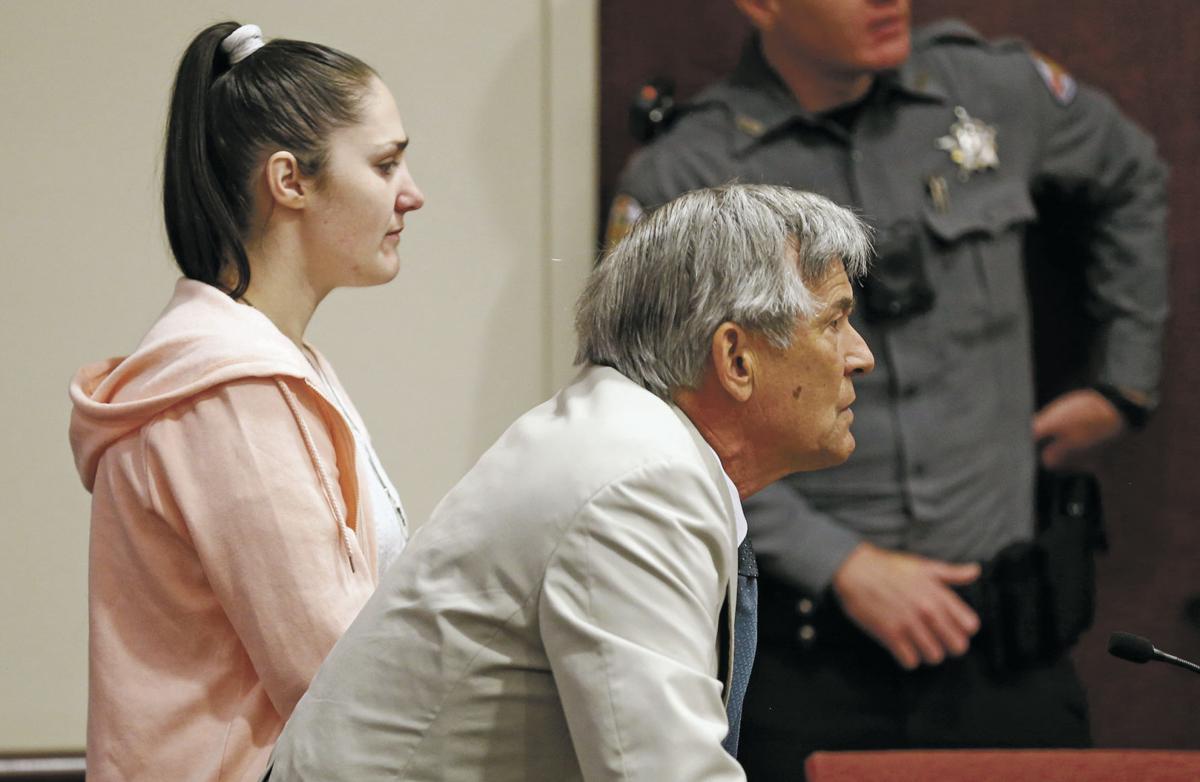
    Rachel Smith sits with attorneys during a hearing in District Court on Tuesday. Smith was being held in the death of 3-month-old she was baby-sitting.PHAEDRA HEYWOODTHE NEW MEXICAN

    Rachel Smith, 27, had been in jail since her March 2017 arrest in connection with the death of the baby boy at a Cerrillos Road motel.

    The infant’s mother — then 17 years-old — had left two children with Smith for five days preceding the death, according to court records, and Smith was living with the children in the Thunderbird Motel when she woke up one morning to find the baby was not breathing.

    Investigators originally speculated that Smith — a heroin addict who admitted shooting up in the bathroom while she was watching the boy and his 2 year-old sister — might have rolled over on the boy. However, an autopsy later revealed the infant had bleeding in his brain consistent with “blunt force trauma.”

    Smith’s defense attorney, Stephen Aarons, filed a motion in November seeking to have the charges dismissed on grounds that her rights to a speedy trial and discovery of evidence had been violated. Among other things, he argued that it took prosecutors about a year to produce Children Youth and Family Department records that could include evidence that the infant’s mother had abused him.

    State District Judge Mary Marlowe Sommer postponed her decision on that motion during a hearing Tuesday, saying she needed to review the Children Youth and Family Department records before ruling.

    Aarons also filed a motion challenging one of the state’s expert witnesses, saying the proposed witness’s opinions on “shaken baby syndrome” as it relates to pinpointing when the child received the fatal injury are not typical and have been contradicted in literature that says determining time of injury is the unreliable “Achilles heel” of forensic pathology.

    Sommer also postponed ruling on that motion Tuesday, directing Aarons and Assistant District Attorney Larissa Breen to expand written briefs on the issue before the judge considers the matter again next month.

  • Sitter’s lawyer requests immunity for mother in testimony about dead boy

    Rachel Smith has spent the better part of the past two years in the county jail awaiting trial on a charge that she caused the death of a 3-month-old infant left in her care in a Cerrillos Road motel room in 2017.

    But Smith’s defense attorney and prosecutors recently told a state district judge that new evidence raises the possibility that the child’s mother, Angel Arellano, might have inflicted the injuries that led to the death of Jonathan Valenzuela.

    Arellano had dropped off the boy and his 2-year-old sister at the motel to be cared for by Smith.

    State District Judge Mary Marlowe Sommer postponed Smith’s trial this month — just three days before it was set to begin — to give investigators time to pursue new leads in the case, including allegations that Arellano confessed to an acquaintance she had hurt her son.

    “It would be extremely difficult, if not unethical, for the state to go forward with the trial at this point without setting our minds at ease that we do indeed have the right person in the courtroom,” Assistant District Attorney Larissa Breen said during a court hearing.

    Smith is now out on bail with electric monitoring. She still faces a first-degree felony charge that could send her to prison for up to 18 years.

    Arellano’s attorney, Marc Edwards, said Friday that he had just taken her on as a client and could not comment for this story. Arellano hasn’t been charged.

    Smith’s defense lawyer, Stephen Aarons, recently filed a motion asking the court to approve an arrangement that he hopes will encourage the child’s mother to testify on Smith’s behalf at trial, even if it means implicating herself.

    Aarons is asking the court to grant “use immunity” to Arellano, who is listed as a witness for the state. Such immunity would prevent prosecutors from using anything she said on the stand during Smith’s trial to prosecute her for her son’s death.

    The immunity would not prevent the state from prosecuting her based on other evidence.

    Without the immunity, Aarons says in his motion, Arellano will invoke her Fifth Amendment right against self-incrimination by remaining silent during Smith’s trial.

    Arellano attempted to abort her son by self-harm while pregnant, screamed that she did not want the baby and threatened suicide before he was born, the lawyer says in his motion. He also wrote that Arellano gave the baby to Smith about 33 hours before his death. “The baby could have been grabbed by the throat and violently shaken before this final exchange,” Aarons wrote.

    Smith assumed care of Jonathan and his sister on March 10, 2017, according to police reports. She told police she fed him and put him to bed but awoke the next morning to find he was not breathing. She then called 911.

    The child had no visible injuries. Smith told investigators she had used heroin the night before, and police originally speculated she may have rolled over on the child in the night.

    An autopsy revealed the boy died from bleeding in the brain caused by blunt force trauma.

    The father of a man with whom Arellano — then 17 — was involved at the time has since told police that Arellano told his son that she had harmed the boy before delivering him to Smith, according to court filings.

    Assistant District Attorney Breen is opposing Aarons’ motion, saying that granting Arellano immunity would devastate the state’s chances of prosecuting her if the Santa Fe Police Department’s renewed investigation reveals Arellano was responsible for the infant’s death.

    “The state has no doubt Defendant would like to have Ms. Arellano have leave to testify she may have actually killed [Jonathan], if that is indeed what she will say,” Breen wrote in a motion filed Friday in state District Court, “but the court has to look at the potential detriment to the public interest in getting justice for [the baby’s] death.”

    A spokesman for District Attorney Marco Serna said in an email that Smith’s attorney hasn’t provided documentation to support new allegations involving Arellano.

    (c) 2019 Santa Fe New Mexican, reprinted with permission
  • Court questions appeal in Fabian Gonzales case

    BY KATY BARNITZ / JOURNAL STAFF WRITER

    ALBUQUERQUE, N.M. — The state Court of Appeals is asking the District Attorney’s Office to explain whether its appeal in the Fabian Gonzales case should be dismissed as moot following his cousin’s no contest plea.

    Gonzales, along with his cousin Jessica Kelley, are defendants in a case centered on the death of 10-year-old Victoria Martens. In an agreement last month with the DA’s Office, Kelley pleaded no contest to reckless child abuse resulting in death, tampering with evidence and aggravated assault. She also promised to testify against Gonzales.

    Prosecutors in September appealed Judge Charles Brown’s decision to exclude statements Jessica Kelley made in jail, along with evidence of her drug use and prior convictions.

    Gonzales had been set for trial in mid-October, but the appeal put his case on hold indefinitely.

    In an order filed last Thursday, the Court of Appeals noted that Kelley’s plea agreement and availability to testify may have rendered moot the argument asserted in the appeal.

    A spokesman for the DA’s Office said prosecutors will file a response in coming days.

    Gonzales’ attorney Stephen Aarons filed a response asking the court to dismiss the appeal and send the case back to the District Court for trial.

  • Gang ties doubted in Martens case

    By Elise Kaplan / Journal Staff Writer Updated: Tuesday, October 2nd, 2018 at 9:02pm

    While the core of the state’s case against Fabian Gonzales rests on his ties to a local street gang and retaliation for threats prosecutors say he made toward rival gang members, Gonzales’ defense attorney has filed motions recently that cast doubt on that narrative.

    The District Attorney’s Office has said that 10-year-old Victoria Martens was raped and strangled in her mother’s apartment in August 2016 because Gonzales threatened rival gang members after a fight at a barbecue a couple of days earlier.

    Prosecutors have written that “the nexus between defendant’s threats to rival gang members and the retaliation that ensued and led to the homicide of Victoria is more than apparent” and claimed repeatedly that Gonzales is a member of the notorious street gang “Thugs Causing Kaos.”

    He is charged with reckless child abuse resulting in death and several counts of tampering with evidence.

    But motions filed by Gonzales’ attorney, Stephen Aarons, question Gonzales’ gang connections.

    “There is no evidence that defendant has ever participated in gang activities or assisted a member of any known gang,” he wrote in a motion. “Defendant did not retaliate for receiving a black eye from a girl, and it is illogical to think he would retaliate in his own home or that some fictitious gang members would retaliate because he was punched in the eye by a girl.”

    In response to emailed questions, Aarons said he believes the District Attorney’s Office is struggling to come up with a motive for the crime.

    “They are NOT saying that Fabian or a member of his ‘gang’ retaliated after he got beat up and hired a hit man to strangle his new girlfriend’s daughter in her bedroom,” he wrote. “Rather, the prosecution is claiming that a RIVAL gang – the judge asked at a recent hearing whether the state thinks there is another gang besides Fabian’s or not – retaliated against something Fabian did after he was beat up at the barbecue party a few days before the murder. The crux of their argument is that an as-yet unidentified gang retaliated when Fabian made threatening texts for several hours after the BBQ.”

    Gang affiliation

    During a stint at the county jail in September 2006, Gonzales did self-identify as a member of the gang “Kriminal Minded Kaos” in an inmate identification sheet, but he said at that time that the gang had disbanded.

    Gonzales, then 21, said that he joined KMK when he was 17. In response to the question, “What did you expect to gain by joining?” Gonzales answered, “I didn’t expect anything I just wanted to show my brother that I love him and I am down for him.”

    Gonzales has “KMK” tattooed on his abdomen and “thug” and “life” tattooed on his forearms, according to booking sheets.

    In response to questions about whether the group is “at war” or enemies with other groups Gonzales said, “The group is gone.”

    A spokeswoman for the Metropolitan Detention Center said that was the only formal interview Gonzales did with the jail’s gang security officers. After subsequent arrests, she said, officers would have kept an eye on Gonzales for any new gang tattoos and would have talked with him about any changes in affiliation.

    If the officers had found signs that he had joined another gang, they would have had him do another formal interview.

    Although initially Gonzales, his cousin Jessica Kelley and Victoria’s mother, Michelle Martens, were charged with rape and murder in the killing of the little girl, last month prosecutors announced a new theory about what happened.

    Kelley has said she was high on methamphetamine and baby-sitting Victoria when a “well-dressed” Mexican man came to the apartment, asked for Gonzales by his street name, and then went into Victoria’s bedroom and killed her.

    In the motions, attorney Aarons downplayed the fight at the barbecue and said interviews with the hosts show that they didn’t believe he was referencing TCK.

    “Further, the people at the barbecue party do not claim to be gang members and did not take defendant seriously when he was upset for getting punched in the eye,” he wrote in a motion.

    The woman who lived in the home and who Gonzales is said to have threatened is not listed in the Metropolitan Detention Center database of gang members, according to a jail spokeswoman.

    Prosecutors say the woman’s boyfriend is in a rival gang, but the man told the defense team’s investigator that he had “left that nonsense when I was a kid,” according to an interview transcript.

    A spokesman for the DA did not answer questions about Gonzales’ gang ties.

    The Court of Appeals is reviewing an appeal by the state on the judge’s ruling excluding statements and other evidence.

    Judge Charles Brown will rule on Aarons’ motions after the case returns to the 2nd Judicial District Court.

    DNA disputed

    Along with gang retaliation, DNA has also been a focus in the evolving case.

    Over the summer, the District Attorney’s Office said it found a partial DNA sample – likely from saliva, hair or skin cells – from an unidentified male on Victoria’s back. More recently, it has said that male DNA was also found under her fingernails and around her neck.

    Last week, Aarons asked for the state to be sanctioned for not turning over all the DNA evidence, a charge prosecutors have disputed.

    “The defendant’s motion is not only without merit but it is in fact wholly frivolous and full of factual misstatements,” prosecutor Greer Rose wrote in response.

    Although Aarons presented the theory that a mixture of DNA from at least five individuals was found on the crotch of a jumpsuit worn by Kelley and could have been transferred to Victoria, Rose said that was “not only outlandish but completely divorced from the actual evidence.”

    The jumpsuit in question did not belong to Kelley. A DA spokesman said the jumpsuit possibly belonged to Victoria and the DNA was not found on the crotch, but on the bottom and the straps.

    While the criminal case is ongoing, Aarons has submitted a tort notice of claim to the city to protect Gonzales’ right to sue for a violation of civil rights.

    On the notice, he says the city is at fault because Gonzales was “wrongfully arrested and detained for the murder of Victoria Martens. Police extracted false confessions and withheld evidence.”

    Copyright © 2018 Albuquerque Journal
  • Rape Charges Dismissed

    Taos NM – Deputy Eighth Judicial District Attorney announced that all charges against Frankie Giron are being dismissed. A three-day jury trial had been scheduled later this month on criminal sexual penetration charges. Santa Fe defense attorney Steve Aarons explained that his client had told police when he was arrested that the woman had consented to sex and had made plans to see him again for a second date at the Gorge bridge.

  • State v. Saavedra (NM App 2017)

    [column width=”1/1″ last=”true” title=”” title_type=”single” animation=”none” implicit=”true”]

    COURT OF APPEALS OF THE STATE OF NEW MEXICO

    No. 36,225

    STATE OF NEW MEXICO, Plaintiff-Appellee,
    v.
    CINDERELLA SAAVEDRA, Defendant-Appellant.

    APPEAL FROM THE DISTRICT COURT OF SAN MIGUEL COUNTY
    Gerald E. Baca
    , District Judge

    Hector H. Balderas, Attorney General Santa Fe, NM for Appellee

    Aarons Law Firm PC Stephen D. Aarons Santa Fe, NM for Appellant

    MEMORANDUM OPINION

    HANISEE, Judge.

    Page 2

    {1} Defendant appeals from her conviction of aggravated battery without great bodily harm. We previously issued a notice of proposed summary disposition in which we proposed to affirm. Defendant has filed a memorandum in opposition thereto. After due consideration, we remain unpersuaded.

    {2} In her memorandum in opposition, Defendant reiterates her position that her testimony that she hit the victim “out of panic” was sufficient to warrant an instruction on simple battery as a lesser included offense because it supported her theory that she did so without any intent to injure the victim. [MIO 2] Defendant argues that her testimony established that she was having a panic attack, citing the fact that, in closing argument, the prosecutor characterized her testimony as having said that she was having a panic attack. [Id.] However, the memorandum in opposition acknowledges that Defendant’s exact words were that she hit the victim over the face and head “out of panic” and does not challenge our observation that prior to doing so and breaking the pool stick in half in the process, Defendant had become enraged, had pushed the victim to the ground, had armed herself with the pool stick after the two had been separated, had instigated the victim to come out of her room again, and had warned the victim not to approach her. [Id.; RP 195-97] Regardless of the prosecutor’s subsequent characterization of Defendant’s testimony, we remain unpersuaded that her isolated statement that she acted “out of panic[,]” without more, “tend[ed] to

    Page 3

    establish that [simple battery was] the highest degree of crime committed.” State v. Pettigrew, 1993-NMCA-095, ¶ 5, 116 N.M. 135, 860 P.2d 777. Contrary to Defendant’s assertion, our notice of proposed summary disposition did not state that “no reasonable jury could believe Defendant when she testified that she struck out of panic.” [MIO 5] Rather, we proposed to hold that her testimony, coupled with the other evidence presented at trial, was “inconsistent with a lack of intent to injure.” [CN 4] Defendant’s reliance on State v. Skippings, 2011-NMSC-021, 150 N.M. 216, 258 P.3d 1008, is misplaced. [MIO 5-6] In Skippings, the victim died after she and the defendant “became entangled, with [the v]ictim straddling [the d]efendant. [The d]efendant sought to extricate himself from [the v]ictim and forced her off of him, resulting in her landing on the asphalt roadway and cracking her skull.” Id. ¶ 6. Unlike the present case, there was no evidence in Skippings that the defendant had armed himself in advance with any type of weapon, and there was evidence in addition to the defendant’s testimony to suggest that he was merely trying to free himself from the victim. Id.

    {3} Defendant further cites State v. Seal, 1966-NMSC-123, 76 N.M. 461, 415 P.2d 845 (reviewing the sufficiency of the evidence to support conviction of simple battery), and State v. Hill, 2001-NMCA-094, 131 N.M. 195, 34 P.3d 139 (reviewing the denial of requested self defense, resisting, obstructing, or evading an officer, and

    Page 4

    entrapment instructions). [MIO 6] Neither one of these cases addresses the issue before us, and thus we fail to see how they support Defendant’s position.

    {4} Defendant further argues that our observation that her testimony was relevant to the issue of self-defense requires reversal. [MIO 7-8] Defendant cites a thirty-year-old out-of-state case dealing with imperfect self-defense as authority for the proposition that ” ‘one who truly believes that there is a need for self[-]defense cannot be said to act with intent to injure.’ ” [MIO 7] (quoting People v. McKelvy, 239 Cal. Rptr. 782 (1987)) (internal quotation marks and alterations omitted). However, the language relied upon by Defendant was dictum by a single judge, and Defendant fails to cite any authority demonstrating that it has been adopted in that jurisdiction or ours. [Id.] See In re Adoption of Doe, 1984-NMSC-024, ¶ 2, 100 N.M. 764, 676 P.2d 1329 (stating that where a party cites no authority to support an argument, we may assume no such authority exists). As such, we remain unpersuaded.

    {5} Defendant further argues that the jury’s questions whether “[the battery] can be thoughtless and spur of the moment?” and “what constitutes purpose and intention to harm?” establish that reversal is in order. [MIO 3] At most, the first inquiry demonstrates that at least one juror questioned the essential element of specific intent, whereas the second inquiry merely demonstrates that at least one juror wished to receive additional definitions. As such, we hold that these questions do not establish

    Page 5

    that there was “some evidence tending to establish that [simple battery was] the highest degree of crime committed.” Pettigrew, 1993-NMCA-095, ¶ 5. For the same reason, we hereby deny Defendant’s motion to supplement the record proper with these jury questions.

    {6} Therefore, and for the reasons stated in our calendar notice, we affirm.

    {7} IT IS SO ORDERED.

    /s/_________
    J. MILES HANISEE, Judge

    WE CONCUR:

    /s/_________
    MICHAEL E. VIGIL, Judge

    /s/_________
    TIMOTHY L. GARCIA, Judge

    This memorandum opinion was not selected for publication in the New Mexico Appellate Reports. Please see Rule 12-405 NMRA for restrictions on the citation of unpublished memorandum opinions. Please also note that this electronic memorandum opinion may contain computer-generated errors or other deviations from the official paper version filed by the Court of Appeals and does not include the filing date.


    [/column]

  • Taos County Jury Verdict

    [column width=”1/1″ last=”true” title=”” title_type=”single” animation=”none” implicit=”true”]

    Defendant sent home after Jury returns verdict in Taos Murder Trial

    The prosecution did not object to Manual Leyba going home after the jury returned a verdict of involuntary manslaughter after the fatal stabbing in Penasco. A sentence hearing is scheduled for June 2016.

    [/column]

    [column width=”1/1″ last=”true” title=”” title_type=”single” animation=”none” implicit=”true”]

    Peñasco man found guilty of involuntary manslaughter

    Laurie Celine Updated May 20, 2016

    Manuel Leyba of Peñasco was found guilty of involuntary manslaughter by a jury (May 19) in the Eighth Judicial District Court before Judge Jeff McElroy in Taos. The verdict was based on an incident that happened when Leyba allegedly stabbed his 22-year-old cousin, Alex Vigil, the night of June 19, 2015. Leyba, 31, was charged with second-degree murder.

    The events leading up to the murder began with a domestic altercation between Vigil and his girlfriend, Tysha Sandoval. Sandoval is the mother of James Leyba’s son, who is Manuel Leyba’s brother. Prosecutors Ron Olsen and David Thomas argued for second-degree murder, while Defense Attorney Stephen Aarons argued for innocence. The prosecutors and the defense attorney described the events leading up to the incident as intricate and complex family relations.

    The jury was instructed to make the decision by examining four possible outcomes: not guilty, self-defense, voluntary manslaughter and involuntary manslaughter, which it ultimately ruled on.

    Copyright Taos News, reprinted with permission

    [Editor’s Note: the four possible verdicts were: guilty of second degree murder, guilty of voluntary manslaughter, guilty of involuntary manslaughter and not guilty]

    [/column]